A Sunday News Review with One Open Question
A Sunday news review turns a week of scattered updates into a clear account of what changed, what still matters and what can wait until next week.
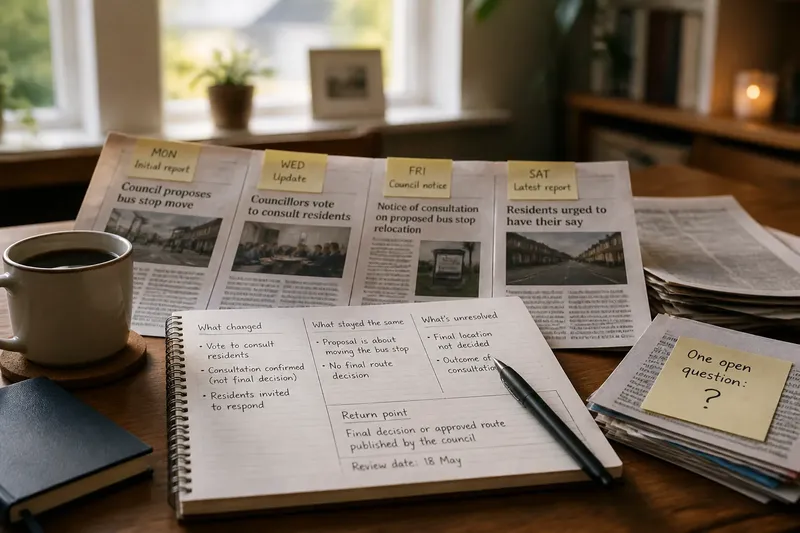
Which story from this week deserves another look—and which can wait? A Sunday news review gives you a way to make that call without reopening every saved link. Start with one story that changed during the week, then trace how its account shifted from the first report to the latest update.
The purpose is not to settle every question or clear your reading queue. It is to notice what changed, what stayed steady and whether the latest version alters what you should understand now. Think of it like sorting a handful of letters: keep the ones that change what you need to do, and set aside the rest.
Choose a changing story
Pick a story that appeared in more than one report or update. A council proposal, a court ruling or a public inquiry may acquire new details as documents appear and people respond. Choose a subject you still care about, not simply the one with the most links.
Give the review a clear boundary: follow one development within the story. For instance, focus on whether a proposal has become a final decision, rather than trying to assess every claim about its wider effects. That boundary helps you compare updates without letting the review turn into a tour of the entire news cycle.
Trace the update sequence
Open the earliest report you saved and the most recent relevant update. If the latest story links to a formal document, such as a council notice or court decision, include it when it helps establish what changed. Note each item’s date and type: an initial report, a later correction, an analysis piece and an official document do not perform the same job.
Compare the wording, not just the headlines. Look for changes to the central claim, the people or institutions involved, the stated timetable and any caveats. A later report may add detail without overturning the earlier account; a correction may change a central fact. Mark that difference plainly.
Keep the comparison focused. If two updates repeat the same information, record that they add no material change and move on. If one introduces a new claim, follow its link to the named document or source only if it bears on the development you chose.
Sort changes and continuities
Use a short set of notes rather than rebuilding a full account of the story. For each update, record what it newly says, what earlier information it confirms, and what it corrects or leaves unresolved. Keep each note close to the wording and scope of its source: a proposal is not a decision, and an announcement is not proof that a change has taken effect.
- Observation: the latest report repeats the earlier account without adding a relevant detail. If so, mark it as no material change; if it introduces a new claim, note that claim and check its stated basis.
- Observation: a correction alters a central name, date or event. If so, revise your account and keep a note that the earlier version was corrected; if the correction concerns a minor detail, record it without overstating its effect.
- Observation: a new document confirms the wording of a decision. If so, update what you understand the decision to say; if it is only a draft, keep it separate from any final decision.
- Observation: a report adds a response from someone affected. If so, note whose perspective has entered the coverage; if no response appears, treat that as a gap rather than assuming what that person thinks.
- Observation: the latest update gives a date for a future action. If so, mark that date as a point to revisit; if it gives no date, leave the timing open rather than guessing.
- Observation: a headline sounds more definite than the report beneath it. If so, base your note on the report’s qualified wording; if both make the same limited claim, preserve that limit in your own account.
When should you revisit the story?
What counts as a meaningful update?
A meaningful update changes a central fact, adds evidence that bears on the question you are following, or clarifies what happens next. A fresh headline alone does not make a new version of the story.
How should you handle a correction?
Use the corrected information in your current account and note what was changed. If the correction affects your understanding of the story, revisit any conclusion that relied on the earlier version.
What if reports disagree?
Identify the exact point of disagreement and check what each report attributes it to. If the available material does not resolve the conflict, record it as unresolved rather than choosing the more confident wording.
When can you stop following updates?
Stop when another update is unlikely to change the part of the story you care about, or when you no longer want to follow it. If a specific future decision or document could change your understanding, use that as your return point.
Work through one update
Say you saved an initial report that a town council had proposed moving a bus stop. A later report says councillors have voted to consult residents, and a council notice confirms that the consultation concerns the proposed move rather than a final route decision. You note the proposal as the starting point, add the vote and consultation as new developments, and keep the final location unresolved. If the council later publishes an approved route, that document would change the status of the proposal; until then, your account should not present the move as settled.
Leave a return point
End the review with one specific event that would make you look again: publication of a final decision, a correction to a central claim, or a report addressing the unresolved issue. Write down the date of your review too. That helps you distinguish what the coverage said then from what later information establishes.
A Sunday news review is useful even when the story has not reached an answer. You can leave with a more accurate sense of what changed and what did not, while giving yourself permission to wait for a relevant update. When next week brings another headline, compare it with the return point you recorded before deciding whether it deserves your attention.